✨ Elevate Your Everyday Style | 🚚 Free Shipping Across India | 💰 Cash on Delivery/ Partial payment Available
✨ Elevate Your Everyday Style | 🚚 Free Shipping Across India | 💰 Cash on Delivery/ Partial payment Available
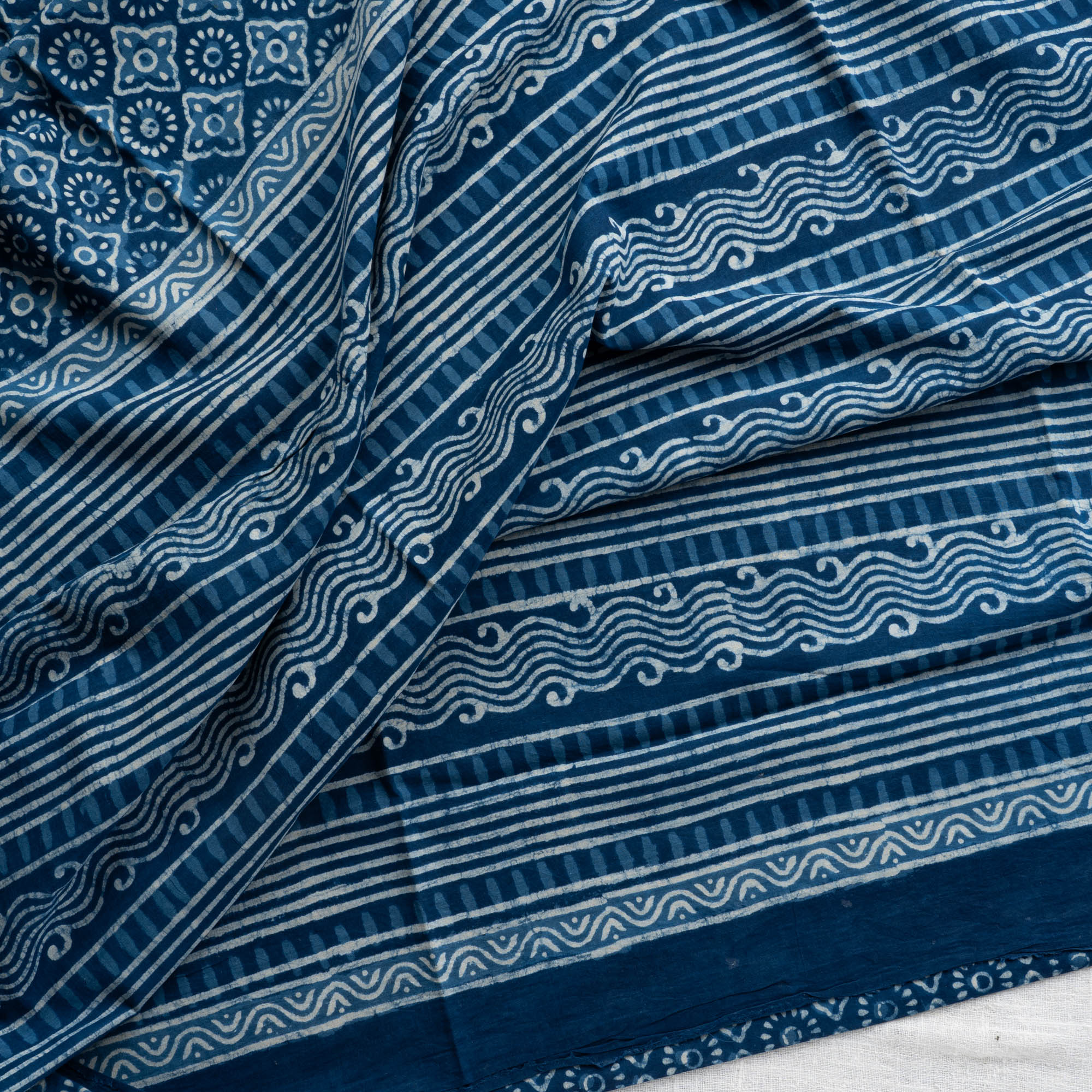
Beautiful Organic Hand Block Print method is a method to print your own designs. Block Printing allows you to customize commercially available fabric.
STEP 1: PREPARING WOOD BLOCKS. The process starts by cutting out wooden pieces with a height of approximately 2-3 inches. ..
STEP 2: PREPARING THE FABRIC. Initially, the fabric is cleansed to eliminate any starch present. …
STEP 3: PRINT PASTE. …
STEP 4: PRINTING. …
STEP 5: FINISHING.
Top of Form
Handblock Mul Cotton | Black | LC0001
In the town of Bagru, India, the art of block printing with natural colour has been passed down through generations. Block print textiles have not only flourished but thrived in India and are popular around the world.
Organic Hand Block Print method is a method to print your own designs. Block Printing allows you to customize commercially available fabric. Block Printing allows you to create a consistant design multiple times. The most important centres for block printing in India are Sanganer, Jaipur, Bagru and Barmer in Rajasthan, Bagh in Madhya Pradesh, Anjar, Deesa, Ahemdabad, Jetpur, Rajkot, Porbandar and Bhavnagar in Gujarat, and Pilakuan and Farukhabad in Uttar Pradesh. Block Printing in India in other forms is widely known as “Woodblock Printing”, “Woodcut Printing” or “Hand block Printing”. The block printing art is done by following a beautiful process where the required designs are carved on the blocks and natural dyes are used for printing on fabrics.
Chinese Historians acknowledge that the Chinese invented xylographie (woodblock) printing between 712 and 756 during the great age of T’ang culture.
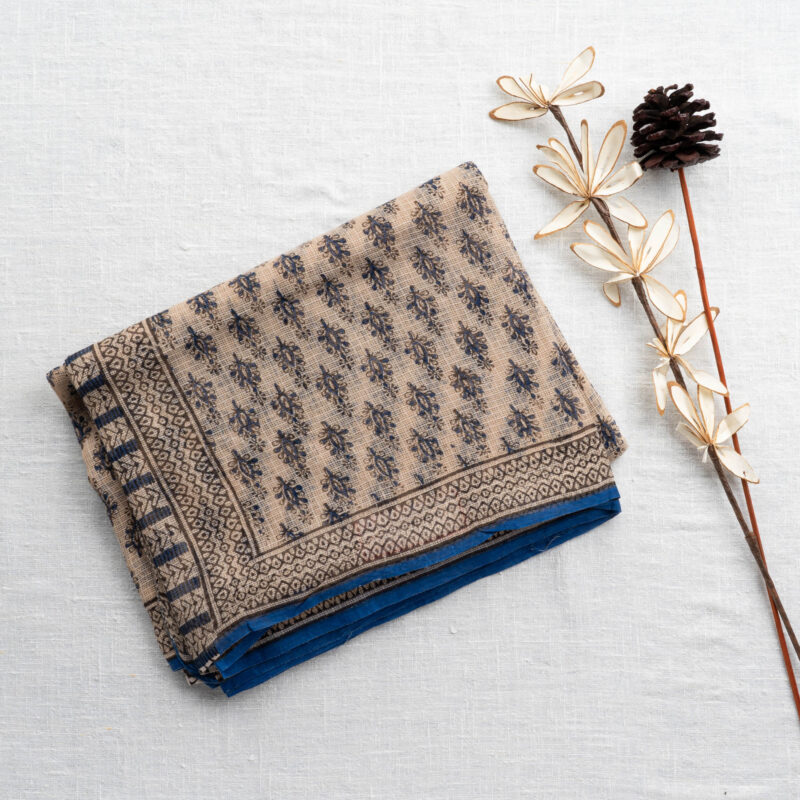
Beautiful Organic Handblock Sarees
Beautiful Organic Handblock Sarees was the Chippa Community of the Bagru District in Rajasthan that brought to light the block printing techniques on fabric. The technique of hand block printing has introduced several printing forms such as Sanganeri Block Print, Bagru Block Print, Ajrakh Block Print, Kalamkari Block Print, and Dabru Block Print. Very This makes it an eco-friendly choice as it reduces carbon emissions.
All my life, I have been exposed to and obsessed by block prints. I remember being in awe of the elaborate themes in the textile gallery of Jaipur City Palace, as well as strolling through busy bazaars filled with stores selling them.
What amazes me, though, is how artisan families with diverse skill sets work together to make the process possible. The way that block makers, rangrez dyers, chippa printers, and dhobis (launderers) collaborate to produce a single piece of hand-block printed textile is just remarkable. I was so thrilled to have the chance to travel to Bagru, a town outside of Jaipur. Bagru was formerly an island in the Sanjharia River and dates back more than 400 years. The town gained notoriety for its organic block (Bagru).
We traveled via tiny, pedestrian-only streets in Chippa ka Mahaulla, Rajasthan, to get to the Dheeraj Chippa printing unit. From there, we turned onto an even smaller gali—an incredibly narrow road—bordered by dye-stained open drains. The typically busy road was unexpectedly empty, and I could still hear his house, which also serves as his printing press, with its incessant “thak-thak.”
Dheeraj Chippa, the proprietor of his own company and an eighth generation block printer, took me through the labor-intensive process of natural dye printing, explaining its sustainability, the difficulties of commercialization, his experimentation with the art, and his response to the current pandemic crisis.
Dheeraj Chippa, a graduate of design and craft school, founded his business in 2016 following the triumphant resuscitation of the traditional phadat print, a distinctive fusion of block and resist printing techniques that had all but vanished from Bagru and his family’s studio. Because phadat print is so rare and demands such skill, he was able to persuade some of the top Indian designers and fashion houses to include it in their luxury collections after successfully replicating the ancient procedure. Naturally dyed and printed block print cloth has become a luxury due to a lack of material resources, the scarcity of high caliber karigars (workers usually connected with the handicraft industry), and rising material and labor costs. The market for unadulterated block prints has evolved today. The prints were initially made available to individuals 400 years ago.
His company is currently struggling, much like the majority of India’s artisan communities. Many orders have been canceled and others have been placed on indefinite hold as the Indian government announced the first phase of lockdown intended to stop the COVID virus from spreading. The main markets are closed and the supply chain is broken. The financial shock that the epidemic has caused many artisan families in Bagru to experience is too great for them to handle, and they are in a desperate situation with no help from anywhere.
Before the global pandemic struck, Bagru’s printing methods were being tested from a variety of angles. A craft that in the 1990s had not only survived, but thrived, is currently facing difficulties. Due to their water-intensive nature The traditional printing method is likewise becoming more commercialized with the arrival of large factories. For them, the lengthy and arduous process of printing with natural colors is the exact opposite of productivity because it raises the cost and decreases the profitability of the printed fabrics. Pigment dyeing, which is cheap, quick, and requires less water, is seeing a resurgence in Bagru in order to lower prices and satisfy the market’s widespread need for vibrant colors.
Dheeraj, like the majority of Bagru’s artisans, had set out to create exclusively naturally dyed and printed yardages on textiles made entirely of silk and cotton. He eventually, though reluctantly, had to accept pigment printing since it was essential to the survival of his entire means of subsistence. However, pigment dyes cause their own problems.
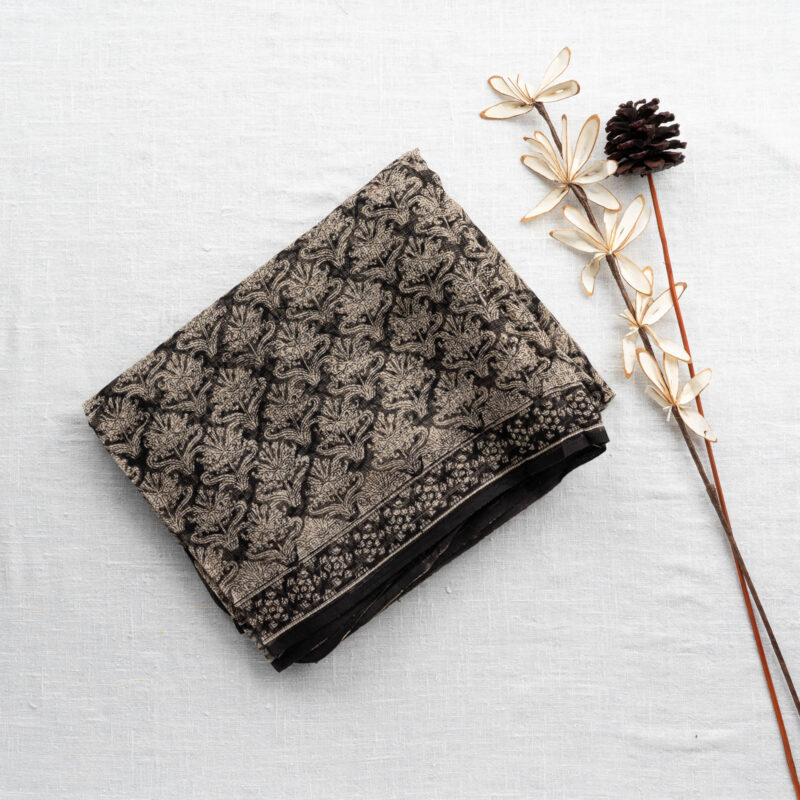
The preparation of the cloth is the first step in the Bagru block printing process, which continues using local techniques to produce the final printed fabrics. Two distinct techniques, direct and resist, are used to transfer designs with unique qualities onto a light-colored background using wooden blocks.
The easternmost regions of Sindh, Kutch, Rajasthan, and Gujarat, were the locations where Ajrak was produced following the division of India. There is some similarity between the names and Patterns and those found in Sindh. Since the Sindhi culture still has a significant effect in Gujarat and some parts of Rajasthan, there are no signs that new traditions are evolving in terms of the patterns that are used. An ancient Indian textile tradition is block printing. Block printed cloth from as early as 2000 BC has been discovered. This cultural custom is still practiced in villages today. We are committed to maintaining block printing as a craft that offers local families a stable means of subsistence.
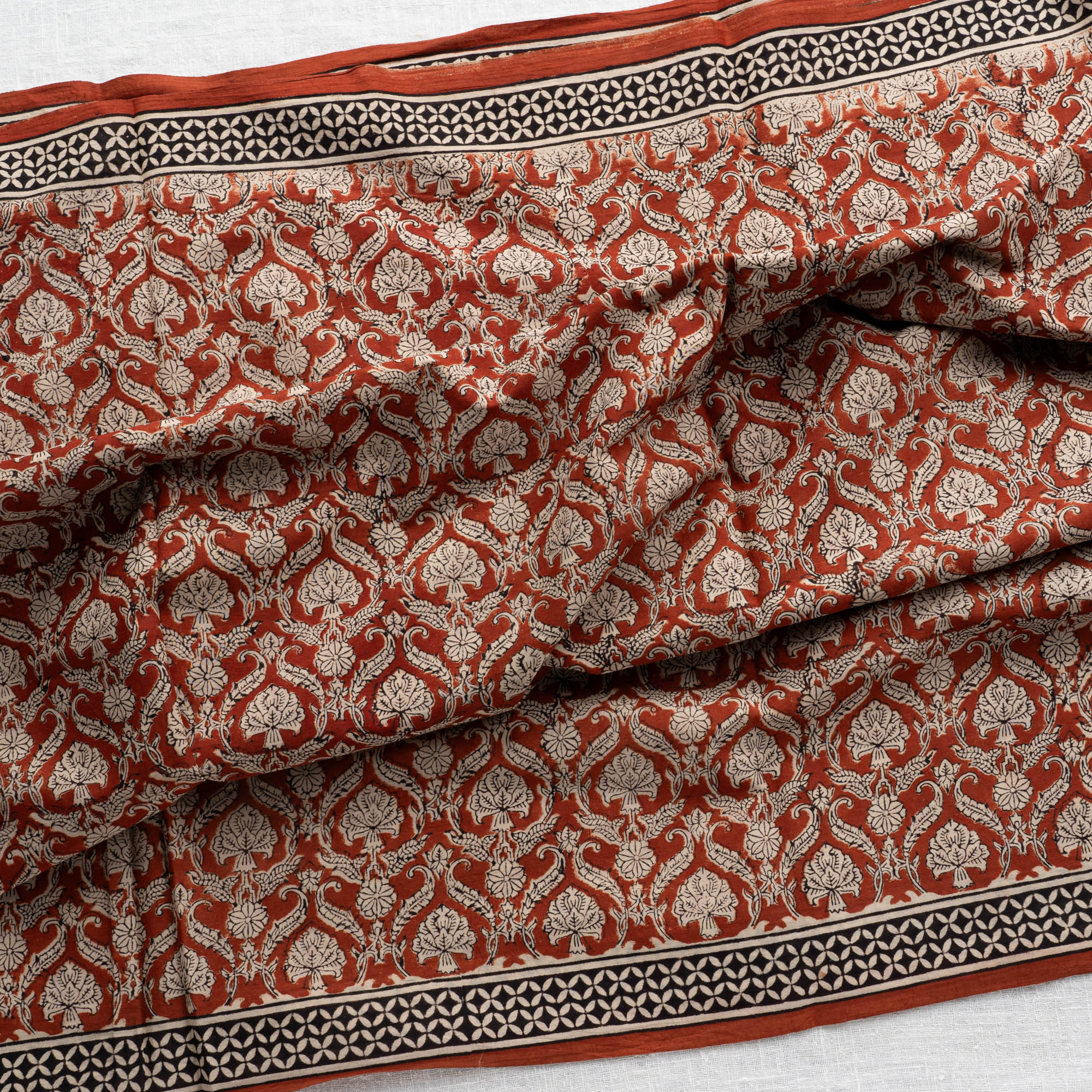
At Real Handicrafts Ajrakhpur, Kutch, Gujarat, India, every piece of fabric is hand-dyed, block-printed, and completed by local artisans utilizing methods and skills that have been passed down through the years. We are a top producer of hand-block printed sarees, dupattas, stoles, bed linens, unstitched suit sets, dress materials, and dress materials in natural and vegetable dyes. The art of hand-block printing supports entire villages.
After the cloth is received from the mills, it is first cleaned to remove any surface imperfections. After that, the blocks are carefully hand-printed on simple cotton after being dipped in natural dyes. Making the mud resist combination with gum, lime, and white chaff is the next stage. It is called the dabu printing method.