✨ Elevate Your Everyday Style | 🚚 Free Shipping Across India | 💰 Cash on Delivery/ Partial payment Available
✨ Elevate Your Everyday Style | 🚚 Free Shipping Across India | 💰 Cash on Delivery/ Partial payment Available
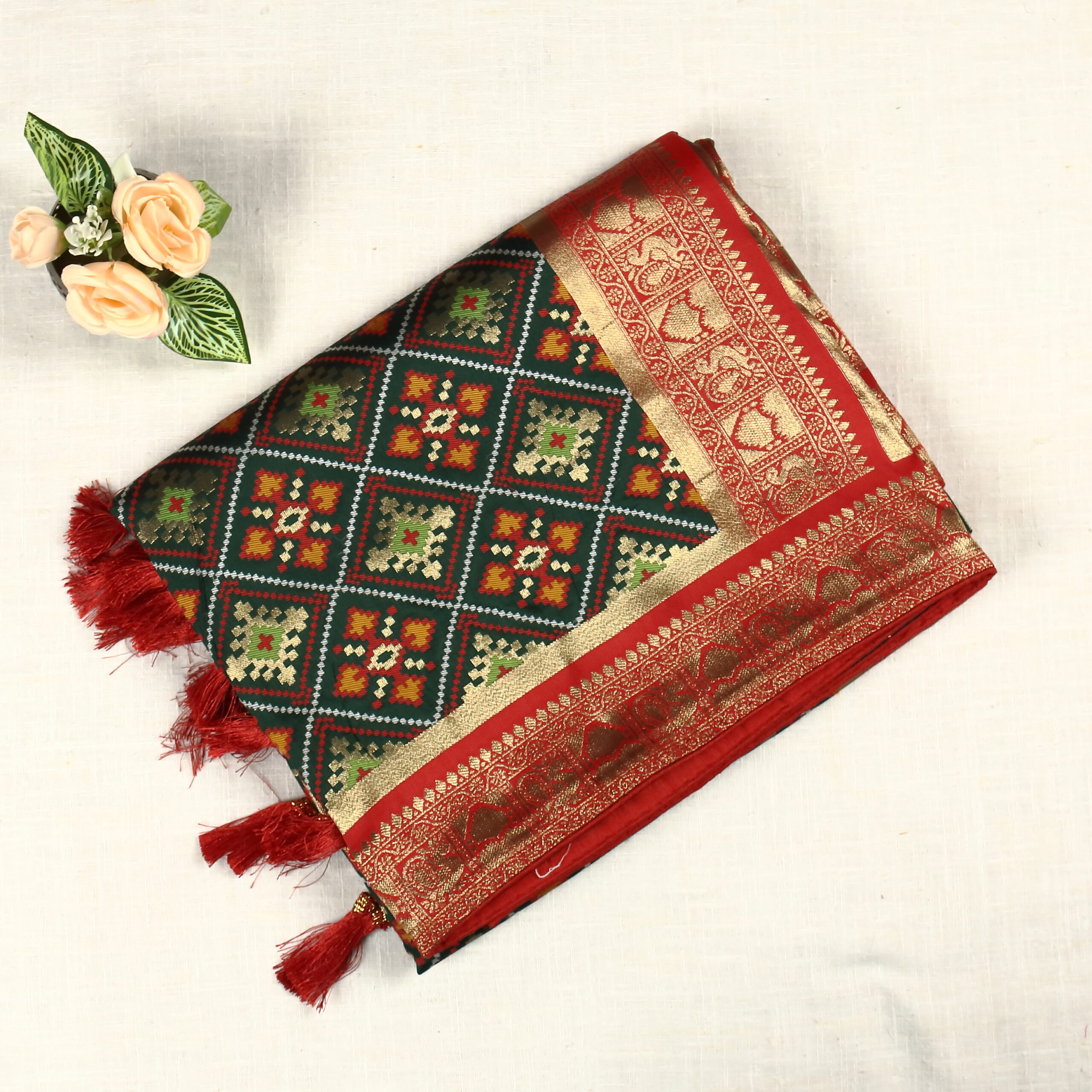
Beautiful Patola Silk Saree | Mustard & Pink | OW0006
With the fall of the Solanki dynasty, Salvis established a prosperous trade in Gujarat. Gujarati women and girls quickly began to associate patola saris with social standing, particularly when worn as part of stridhan—items that a woman can claim as her own. The history of patan art extends over 850 years. It is thought that the Bunkar people, who were originally from South India, introduced the craft of patola weaving to Gujarat. Originally made for the nobility and monarchy, patola sarees’ elaborate patterns and decorations represented the wearer’s social and cultural standing.
Both the warp and weft threads are wrapped to resist the dye in the design that will be used on the finished woven fabric to make a patola sari. For every color that will be used in the finished textile, this tying is repeated. Double ikat is the term for the process of dying the warp and weft before weaving. Before dying, the thread bundles are carefully tied.
The warp and weft technique is used in the resist-dying process to create patolas. It’s costly and time-consuming, requiring three artisans to work on each saree for almost four and a half months. The length and complexity of the pattern determine how long it takes to manufacture a single saree.
The Salvi community in Gujarat is the primary weaver of four unique patterns. Double ikat saris with complete designs of parrots, flowers, elephants, and dancing figures are commonly worn in the Jain and Hindu cultures. Muslim women typically wear saris with geometric and floral patterns, mostly for weddings and other special occasions. Brahmins from Maharashtra use saris with a bird motif known as Nari Kunj and simple, dark-colored borders and bodies.